

Three Wakers coordinate lead discovery, customer insights and lead operations, freeing sales teams to focus on customer conversations and business development.
People working in B2B sales rarely complain about having too many leads.
The real questions are: Why is a company worth contacting? What signal has it just sent? Which solution might it need? Who should you approach? And once the list reaches business development (BD), is anyone following up?
Without answers, even the longest list is just a spreadsheet.
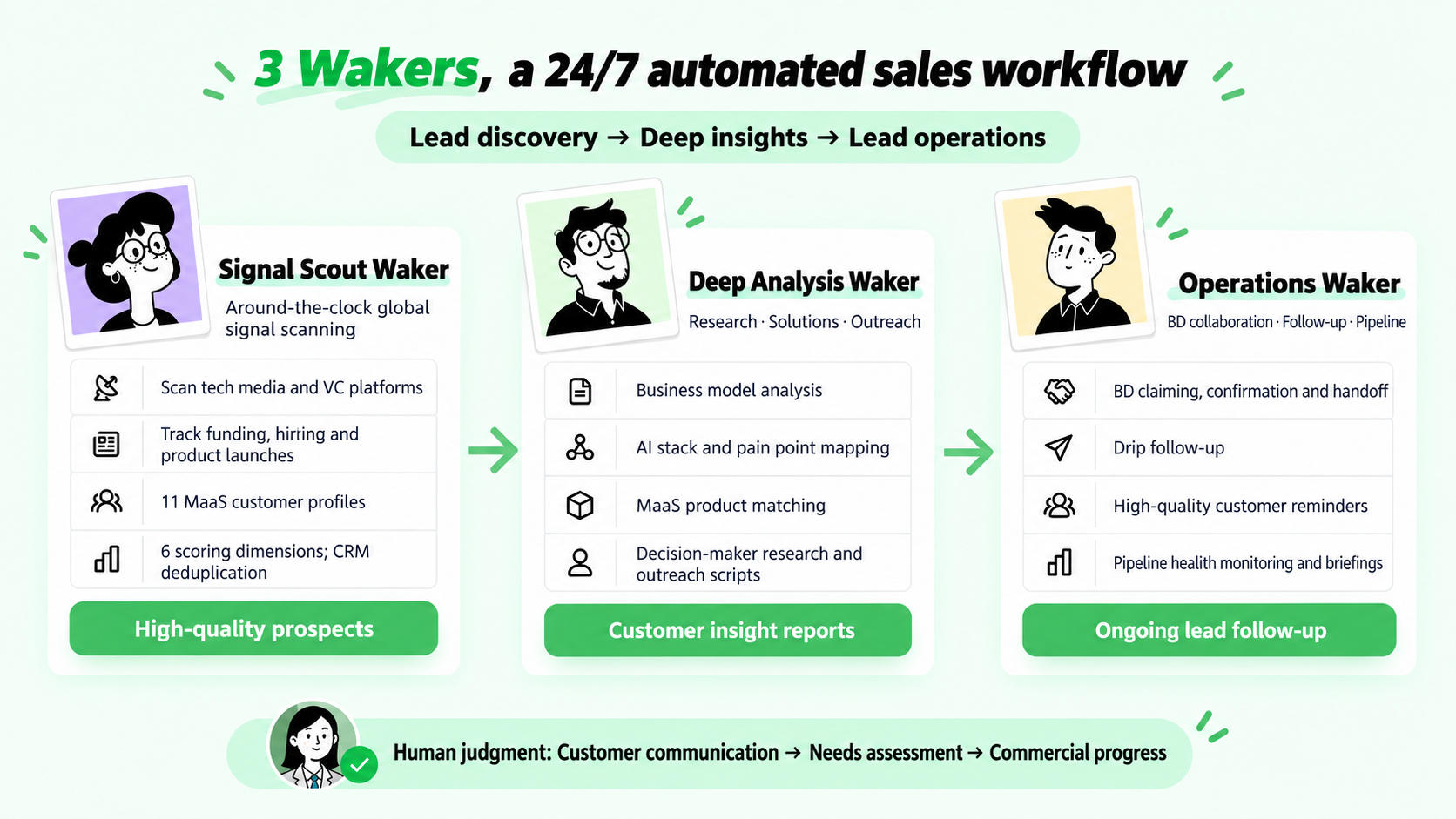
Alibaba Cloud's international sales operations team for its overseas business built a MaaS Hunter Agent with QoderWake. Three digital employees work together: the Signal Scout Waker, the Deep Analysis Waker and the Operations Waker. Together, they automate the entire “Lead discovery → Deep insights → Lead operations” workflow, 24 hours a day, seven days a week.
This Agent does more than find companies online. It identifies prospects from global market signals, adds business context, technical needs and solution recommendations for each company, then brings high-quality leads into the BD team's workflow and keeps tracking their progress.
A sales lead becomes more than a company name: it becomes a customer opportunity that BD can act on.
The MaaS market moves quickly. Funding, hiring, product launches and shifts in technical direction can all signal an emerging need at a company.
The Signal Scout Waker scans high-value sources such as TechCrunch, Hacker News, a16z and 36Kr around the clock, tracking funding announcements, hiring for key roles and product launches.
It does not send every new company name straight to sales.
The team first defined 11 MaaS customer segments and six scoring dimensions for prospects. Using these rules, the Signal Scout Waker screens candidates and scores them from 0 to 10. It then checks for duplicates against the CRM and the global existing-customer pool, removing duplicate customers and companies that do not meet the requirements.
It hands the next Waker a set of candidate companies with signal sources, customer profiles and scoring rationale, rather than isolated names.
Finding a company is only the beginning.
The Deep Analysis Waker takes the candidate list and researches each customer further. It analyzes the company's business model, maps its AI technology stack and potential pain points, matches its needs to MaaS product capabilities, and looks for key decision-makers.
The findings become an HTML customer insight report. Alongside customer background and supporting evidence, the report includes a tailored “1+1” solution recommendation and outreach messaging that BD can use as a reference.
The Deep Analysis Waker therefore delivers more than a lead still waiting for information: it delivers working material ready for sales preparation. BD can review the customer assessment, solution fit and decision-maker information before deciding whether to make contact and how to approach the conversation.
Once the insight report is complete, the Operations Waker takes the third leg of the relay.
It sends high-quality prospects and insight reports to DingTalk, supporting BD lead claims, transfers and feedback on outreach results. For claimed leads, it sends reminders at T+3, T+6, T+9, T+12 and T+14. If nobody follows up, the lead is released again so the opportunity does not remain indefinitely under one person's name.
One BD colleague reported in the group that five companies had been contacted. The Operations Waker immediately changed their status from “Assigned” to “Contacted” and recorded a cooldown period to prevent repeated outreach in the short term.
Claims, transfers, outreach, follow-ups and releases are continuously written back to the Pipeline. The sales team can see which customers are waiting to be claimed, which have been contacted, which have moved to later stages, and whether the overall sales pipeline is healthy.
This step does not decide whom BD should contact or conduct business conversations on behalf of sales. Digital employees prepare materials, move the process forward and maintain status. People remain responsible for customer priorities, outreach methods and final business decisions, as well as the actual business conversations.
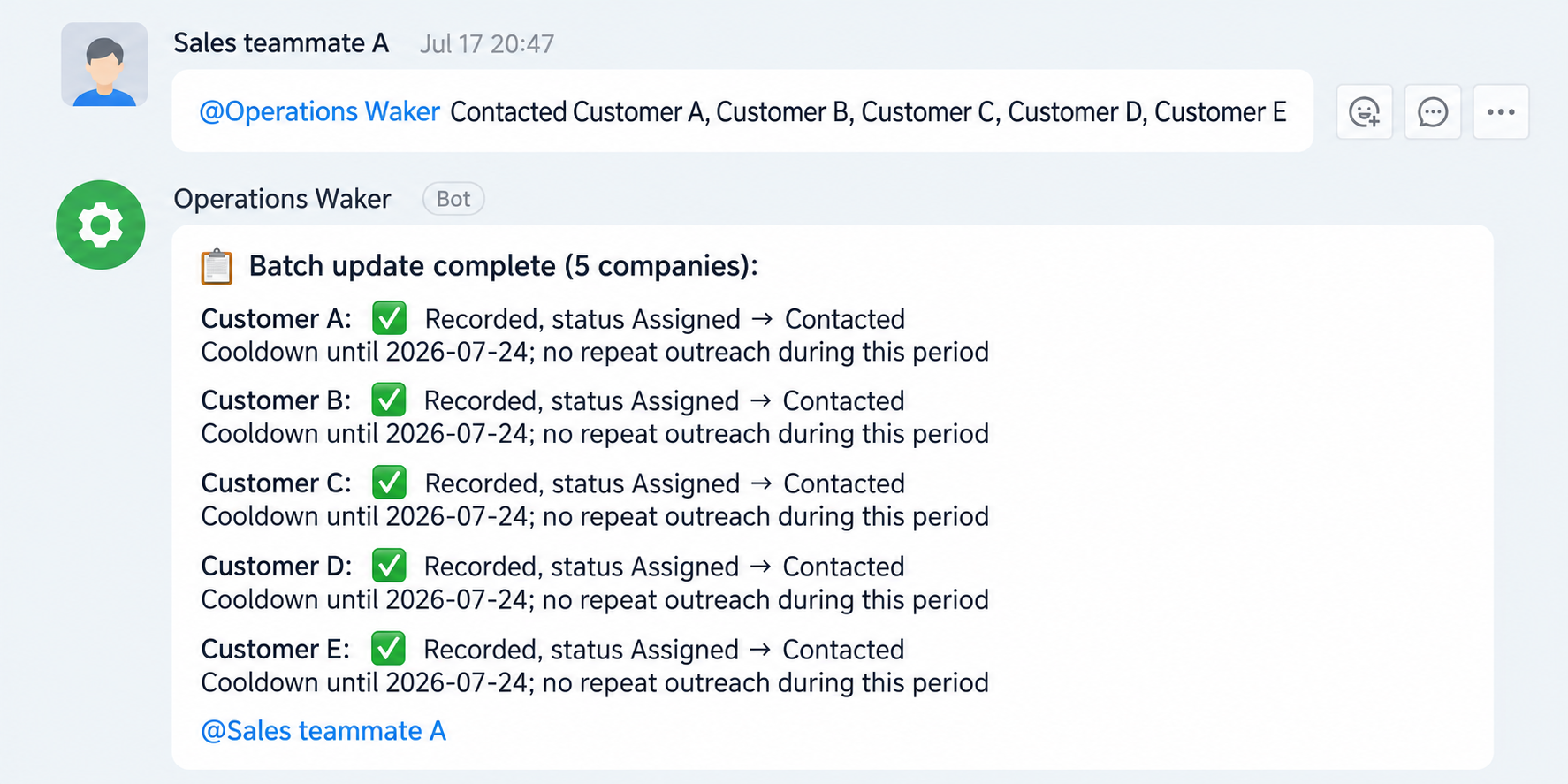 The images above are English translations of the original workflow diagram and collaboration record.
According to the team's first-month trial statistics, the workflow identified 1,030 companies. Of these, 79 were contacted, 10 entered a proof of concept (POC), and three signed contracts.
These results came from the combined work of the digital employees, the sales development representative (SDR) team and subsequent business development. They validated the workflow: prospects identified through public signals can enter a real sales pipeline through screening, insights, lead claims and follow-up.
The sales team now receives more than a list of companies that need to be researched from scratch.
Each lead comes with the reason it was discovered, a customer profile and score, a full insight report, solution fit, key contact leads and next steps. Digital employees handle broad scanning, information organization, report generation and status maintenance, leaving SDRs more time for customer conversations, needs assessment and business development.
Looking back at this practice, the most reusable part is neither a particular search prompt nor a customer list, but the way sales work has been broken down.
Broad scanning of public information, repetitive research organization, report generation and status reminders can be handled by digital employees. People remain responsible for customer priorities, outreach methods, solution trade-offs and final business decisions.
When three Wakers connect this workflow, sales receives more than “There may be a customer here”: it receives an opportunity with signals, context, a proposed solution and a next action.
If your team repeatedly goes through “Find lists → Gather information → Chase follow-ups,” start with one customer segment and one set of market signals. Let QoderWake run that minimal sales workflow first, then gradually expand the digital employees' responsibilities.
Signal Scout Waker: Find prospects in global market signals
The MaaS market moves quickly. Funding, hiring, product launches and shifts in technical direction can all signal an emerging need at a company.
The Signal Scout Waker scans high-value sources such as TechCrunch, Hacker News, a16z and 36Kr around the clock, tracking funding announcements, hiring for key roles and product launches.
It does not send every new company name straight to sales.
The team first defined 11 MaaS customer segments and six scoring dimensions for prospects. Using these rules, the Signal Scout Waker screens candidates and scores them from 0 to 10. It then checks for duplicates against the CRM and the global existing-customer pool, removing duplicate customers and companies that do not meet the requirements.
It hands the next Waker a set of candidate companies with signal sources, customer profiles and scoring rationale, rather than isolated names.
Deep Analysis Waker: Understand customers before BD reaches out
Finding a company is only the beginning.
The Deep Analysis Waker takes the candidate list and researches each customer further. It analyzes the company's business model, maps its AI technology stack and potential pain points, matches its needs to MaaS product capabilities, and looks for key decision-makers.
The findings become an HTML customer insight report. Alongside customer background and supporting evidence, the report includes a tailored “1+1” solution recommendation and outreach messaging that BD can use as a reference.
The Deep Analysis Waker therefore delivers more than a lead still waiting for information: it delivers working material ready for sales preparation. BD can review the customer assessment, solution fit and decision-maker information before deciding whether to make contact and how to approach the conversation.
Operations Waker: Bring high-quality leads into BD's workflow
Once the insight report is complete, the Operations Waker takes the third leg of the relay.
It sends high-quality prospects and insight reports to DingTalk, supporting BD lead claims, transfers and feedback on outreach results. For claimed leads, it sends reminders at T+3, T+6, T+9, T+12 and T+14. If nobody follows up, the lead is released again so the opportunity does not remain indefinitely under one person's name.
One BD colleague reported in the group that five companies had been contacted. The Operations Waker immediately changed their status from “Assigned” to “Contacted” and recorded a cooldown period to prevent repeated outreach in the short term.
Claims, transfers, outreach, follow-ups and releases are continuously written back to the Pipeline. The sales team can see which customers are waiting to be claimed, which have been contacted, which have moved to later stages, and whether the overall sales pipeline is healthy.
This step does not decide whom BD should contact or conduct business conversations on behalf of sales. Digital employees prepare materials, move the process forward and maintain status. People remain responsible for customer priorities, outreach methods and final business decisions, as well as the actual business conversations.