

One handles data requests in group chat; the other supports business analysis. How a Hema analyst shares daily work with two digital employees.
This is the first story, based on an interview with a Hema data analyst. Names and some business details have been anonymized.
“Could you pull yesterday’s GMV?” “Break down users whose monthly cards are about to expire by card type.” “Then split it by city, platform, and user type—ideally in a table.”These requests are familiar to data analysts. Finding tables, confirming metric definitions, changing SQL, running queries, checking results, and exporting data may take only ten or twenty minutes each time, but they repeatedly interrupt analysis work. At Hema, an analyst supporting operations used QoderWake to set up two digital employees, or Wakers: a data retrieval Waker handles frequent data requests in group chat, while a business analysis Waker helps explore questions and produce analytical reports. The two teammates have distinct responsibilities, and each has learned from the team’s previous work.
Data retrieval Waker: a first stop for data requests in group chat
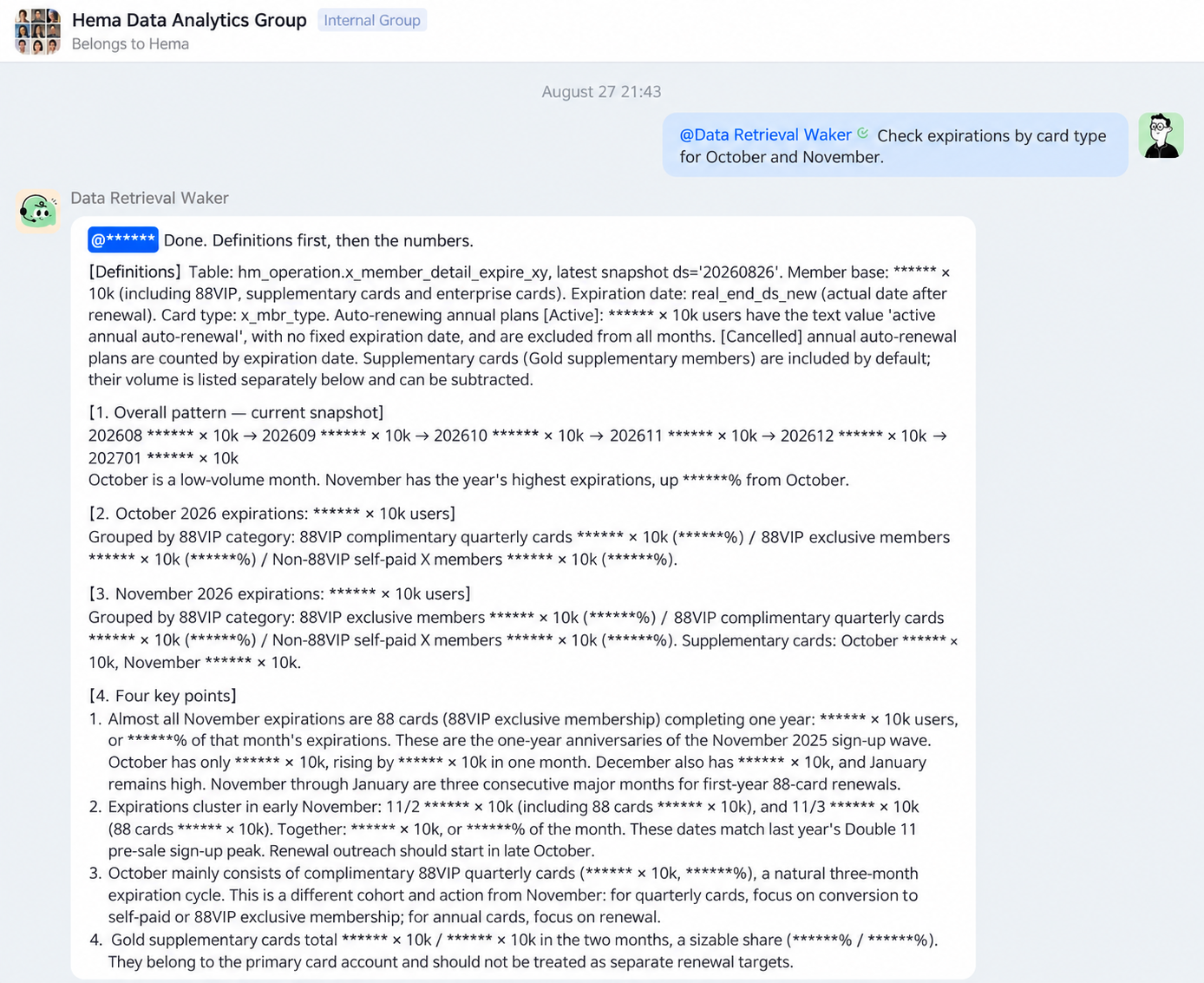
Data requests tend to pile up before weekly and monthly reports. For monthly-card expiration statistics, for example, business colleagues first ask for results by card type, then want city and user type added.
Previously, every additional condition meant the analyst had to revise the SQL, run it again, and post the results back to the group. Now, colleagues can directly @ the data retrieval Waker in the chat.
It uses the business rules prepared by the team to locate tables, generate and execute SQL, and return the results. When additional dimensions are needed, colleagues can follow up with more conditions, and it continues querying within the existing task.
The response includes the SQL, metric definitions, and calculation logic. Whether it counts parent orders or sub-orders, transactions or items must be clear. When a file is needed, it can also organize the results into an online spreadsheet.
Colleagues can keep asking questions, while the analyst can check what was queried and how it was calculated, correcting deviations when they appear.
According to the analyst, at the time of the interview the group served more than 20 business colleagues, around 10 of whom had developed a regular habit of using it. At peak times, there were more than 10 data retrieval tasks a day, and the data retrieval Waker handled some of them.
Business analysis Waker: explore first, then refine the report together
Business analysis for management often involves more open-ended questions.
How much benefit did a membership perk generate, and at what cost? Which groups were affected? Did the differences mainly come from cities, dates, card types, or channels?
Deciding where to look first often takes the most time. Analysts repeatedly revise SQL and examine dimensions and metrics one by one before discovering that a problem is concentrated in particular cities, days, or user groups.
The business analysis Waker helps with this initial step.
The analyst provides the project background, questions to answer, and initial ideas. Using analytical frameworks accumulated by the team, it explores data across multiple dimensions, filters out areas with little change, and flags cities, dates, or groups worth investigating further.
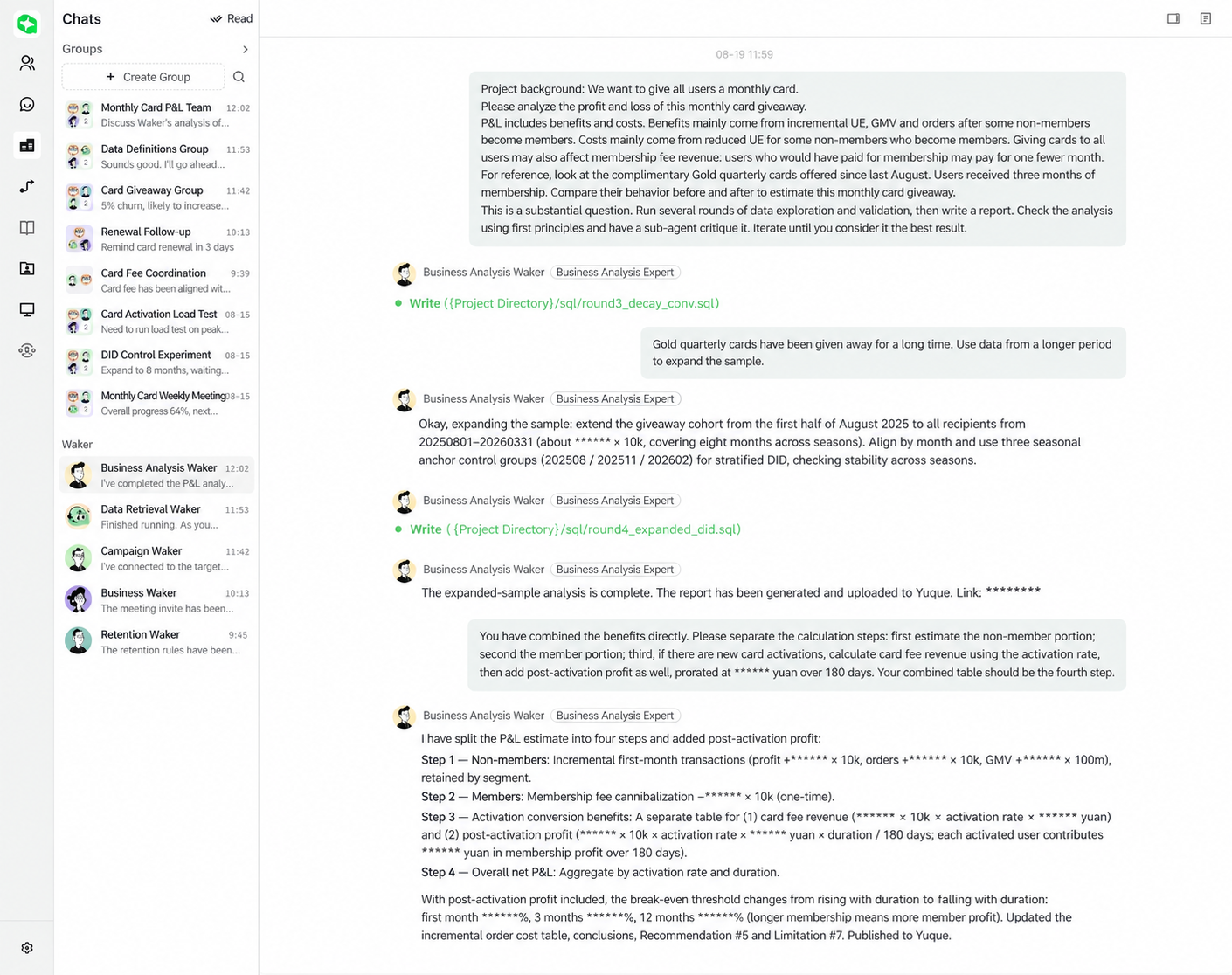
According to the analyst, in one profit-and-loss analysis of monthly membership cards, the business analysis Waker produced a first report in less than two hours.
The analyst then worked through it with the Waker, revising each part.
If the sampling approach was unsuitable, they switched to the full dataset. If the underlying figures did not match, they opened up the SQL and checked it again. If the analysis method was inappropriate, they adjusted it and reassessed whether the conclusions held up.
The report’s presentation also needed work. The Waker listed many possibilities, and the analyst had to cut material from the reader’s perspective, clarify the central issue, and check that the figures were consistent throughout.
The first draft brought these discussions forward. With data, leads, and preliminary conclusions available, the analyst could focus on verification and judgment: deciding which directions deserved deeper investigation and which conclusions still needed evidence.
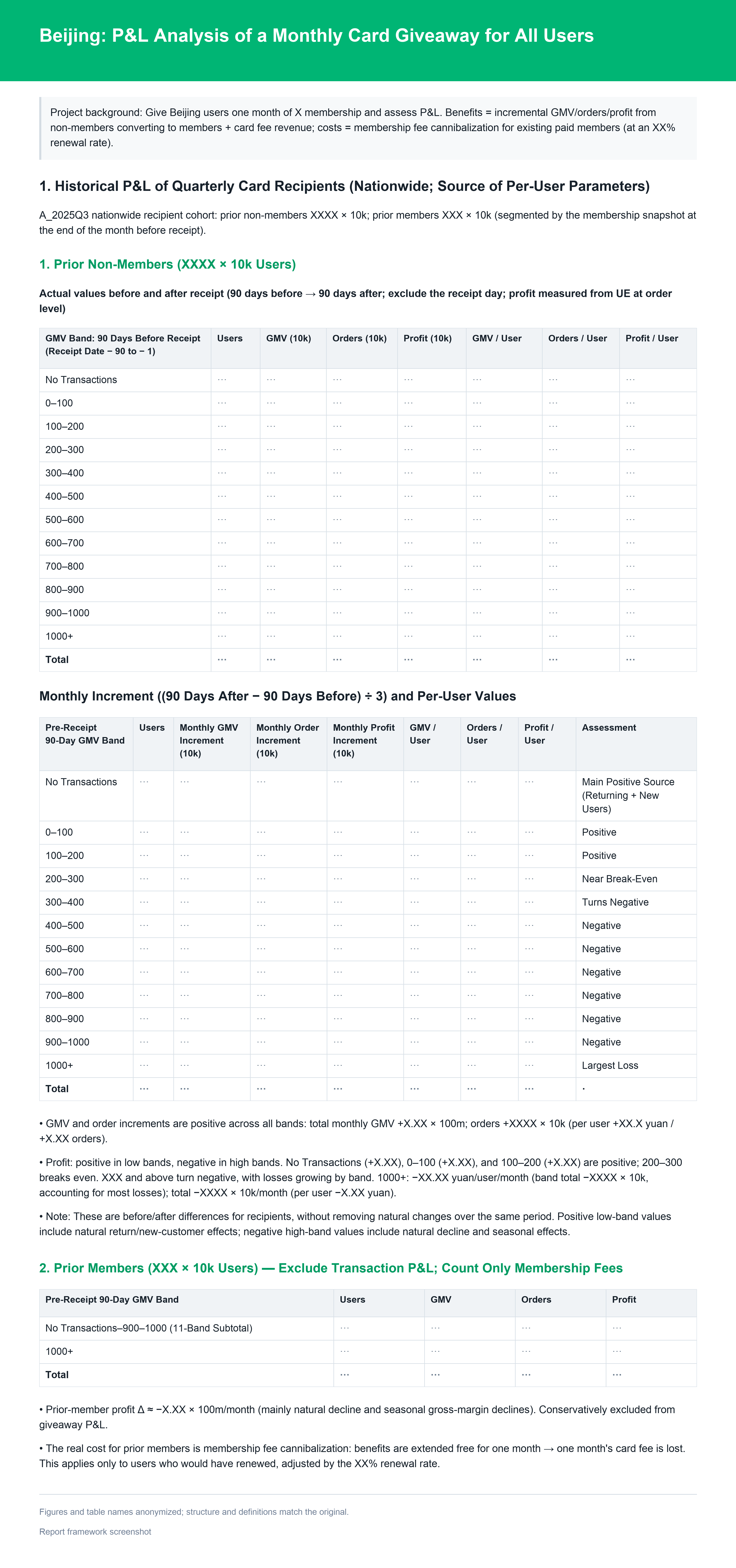
Part of the report framework, taken from the anonymized version supplied with the original article.