

Qoder's Experts Mode automatically breaks down requirements and dispatches multiple expert Agents to develop in parallel—one paragraph is enough to build and refactor a personal blog.
AI Coding has finally leveled up to collaborative teamwork.
That was my reaction after recently testing Alibaba Qoder's "Experts Mode." Under Experts Mode, Qoder directly organized a cyber engineering team for me—I just watch, and the expert team does the work.
It automatically parses my requirements, assigns tasks, and dispatches "engineers" with different responsibilities—frontend, backend, testing, and operations—driving multiple agents to advance tasks simultaneously, letting me be a CTO lying down.
This reflects a new trend in AI Coding: vibe coding is moving toward multi-agent collaborative programming, AI has turned developers into Agent managers, and the AI IDE is becoming an agent-management tool.
After opening Qoder in Editor mode, click "Toggle AI Sidebar" in the top-right corner, then click the mode-switch button at the bottom center, and you can use Experts Mode.
To quickly test the expert team's capabilities, I chose to start from scratch and build a simple personal blog project. After I entered the project requirements, the expert team's "commander," the Team Lead, automatically broke my requirements into 8 tasks and dispatched them to different cyber engineers.
The first one the Team Lead sent out was general engineer Nick. He isn't responsible for the actual development—since I currently had only an empty folder and lacked the environment the project needed, Nick first had to install dependencies for me, set up the basic project structure, and initialize the project.
During this process, Nick also ran into some problems, which it overcame on its own.
In the end, Nick smoothly completed the task and reported back to me.
Then Nick handed off the work to his "colleague"—backend engineer Jimmy. But unlike a human backend engineer who handles both backend development and the database, Jimmy was only responsible for initializing the database—showing just how fine-grained the division of labor is in Experts Mode.
After Jimmy finished building the database, the project could officially start writing code. The Team Lead divided the work by module among 5 engineers, who were respectively responsible for frontend pages, middleware, and backend API development—very comprehensive.
It looks like a linear process, but in fact multiple engineers were advancing the project at the same time during development. This undoubtedly sped up development efficiency, and it's also one of the advantages of multi-agent collaborative programming under Experts Mode.
After the previous 7 "colleagues" completed development, the project commander Team Lead also arranged for testing engineer Chris to perform full-process validation.
Chris directly opened the browser, entered the account and password, logged into the website, and then fully tested the entire create-read-update-delete logic.
At the same time, it automatically saved screenshots of key pages to display the test results.
After the testing was done, the project development still wasn't over—I also had the system review the code quality, so the Team Lead added another expert, code reviewer Mark, who found multiple system vulnerabilities and even graded them by severity.
I then had the expert team fix the vulnerabilities. The experts didn't fix them one by one directly; instead, they first analyzed the situation, then found that two tasks had no dependency on each other and could be developed independently, so two experts completed the tasks in parallel—clearly more efficient.
At this point, all development and testing work was complete. With the help of the 8 experts on Qoder's expert team, it took me just 16 minutes to have a personal blog website. It has complete create-read-update-delete logic, with a front-end display page and a back-end management page.
But the technical architecture was still rather crude, without frontend-backend separation, so I decided to raise the difficulty and test the expert team's refactoring ability, asking it to refactor the backend using Spring Boot (a Java development framework) and MySQL (a relational database).
I first, as before, told the Team Lead my requirements. After a feasibility analysis of these requirements, the Team Lead asked me a few questions, each offering three options; after I made my decisions, the Team Lead then dispatched a new expert, Alex.
Alex is a researcher, responsible for analyzing my current project structure and code interfaces, then formulating a complete refactoring plan and writing it into markdown to guide the subsequent spec-driven development.
With the refactoring plan in place, the Team Lead began directing the engineering team to work, and a new role appeared: operations engineer Nick, responsible for installing MySQL for me.
After MySQL was installed locally, I worried there might be version conflicts between different components, so I stepped in at this point to raise the question on my mind, and the system gave a reassuring answer. This is also a feature of Qoder's Experts Mode: developers can step into the process at any time to raise questions or change requirements.
This design is quite true to life—after all, which developer has never had a product manager tack on extra requirements (doge).
Next came the normal advancement of the project and automatic debugging. Frontend and backend were advanced simultaneously multiple times along the way, and in the end the project was efficiently refactored and the tech stack was rewritten.
But I didn't stop there. How can software built by AI Coding not have AI? I again asked the expert team to integrate the Qwen API for me and set a theme, so that AI could directly write articles for me in the future. It's really not so I can slack off later.
After receiving my requirements, the Team Lead created a new task and arranged frontend and backend engineers at the same time to deliver the feature.
From development to refactoring, I summoned 13 programmers just by moving my lips, completing as many as 30 tasks.
Looking at the entire process, compared with other AI IDEs, Qoder's Experts Mode showed many unique strengths. So, why do we need an "AI Coding expert team" now?
Because AI Coding is ushering in a new paradigm shift.
"Since last December, AI Coding has undergone a qualitative change"—this remark by the guru Karpathy recently sparked heated discussion in the industry.
Karpathy once proposed and popularized the concept of "Vibe Coding," and now he has once again perceived a shift in the direction of AI programming. Karpathy believes that AI programming agents are now far more capable than before and can tackle large projects and long-term tasks.
This means AI programming has shifted from Vibe Coding to Agentic Engineering—AI is no longer just simply completing code, but has begun to fully build projects in the form of agents.
The new paradigm in AI programming has also given rise to new problems.
On one hand, there's the code quality problem. Currently many mainstream AI Coding tools are still single-agent-based; they're fine for simple tasks, but once facing complex tasks—such as multi-round iteration or refactoring a project—their context length may not hold up, ultimately making development like a bear picking corn: working on the feature at hand while forgetting the earlier tasks, with a fragmented logic chain and worrying code quality in the end.
On the other hand, there's room to improve efficiency. Large projects are very complex, involving all kinds of work—frontend UI, backend development, and database design. Some tasks could clearly be executed separately, and real-world teams often arrange them that way, but under single-agent programming, you're still forced to wait.
Qoder's Experts Mode happens to solve both pain points of quality and efficiency. From the hands-on experience above, the expert team isn't simply piling up the number of agents—it's a true multi-agent system. Because the experts it assigned me have different specialties, and as described they actually work in their own independent contexts, so with mutual collaboration they can clearly handle more interaction rounds.
To address the context problem, Qoder specially built an engineering knowledge engine—a code cognition system that can use multi-dimensional data sources, integrating your code files, commit history, Repo Wiki, and memory to optimize the experts' ability to deeply understand context.
In addition, during testing I repeatedly found scenarios where multiple experts advanced work at the same time—in which case the experts wrote different pages separately, or developed frontend and backend separately, which undoubtedly sped up the project's progress.
These are the characteristics I've perceived so far. It's said that the expert team's agents also autonomously learn new Skills, self-evolve, and get smarter and more attuned to me the more I use them. The new mode just launched, so I haven't discovered this feature yet; I'll share more with everyone when I have the chance.
Overall, Experts Mode speeds up development efficiency and improves code quality. Qoder tested Experts Mode's code quality using an internal complex-task benchmark, and the results showed that Experts Mode scored 67% higher than its own single-agent mode, leading Claude Code Agent Teams by 16%.
Clearly, Qoder's Experts Mode is opening a new stage.
After vibe coding and agentic coding, AI Coding is shifting toward the era of multi-agent collaborative programming.
Behind this is a change in user needs: they are no longer satisfied with AI simply writing code, but hope that AI can efficiently deliver software, with guaranteed software quality. A single agent clearly can no longer meet this need, so moving toward multi-agent collaborative programming becomes inevitable.
Multi-agent collaborative programming further amplifies individual capability, giving an individual a digital legion that is on standby at all times, continuously evolving, and understands not just programming but engineering.
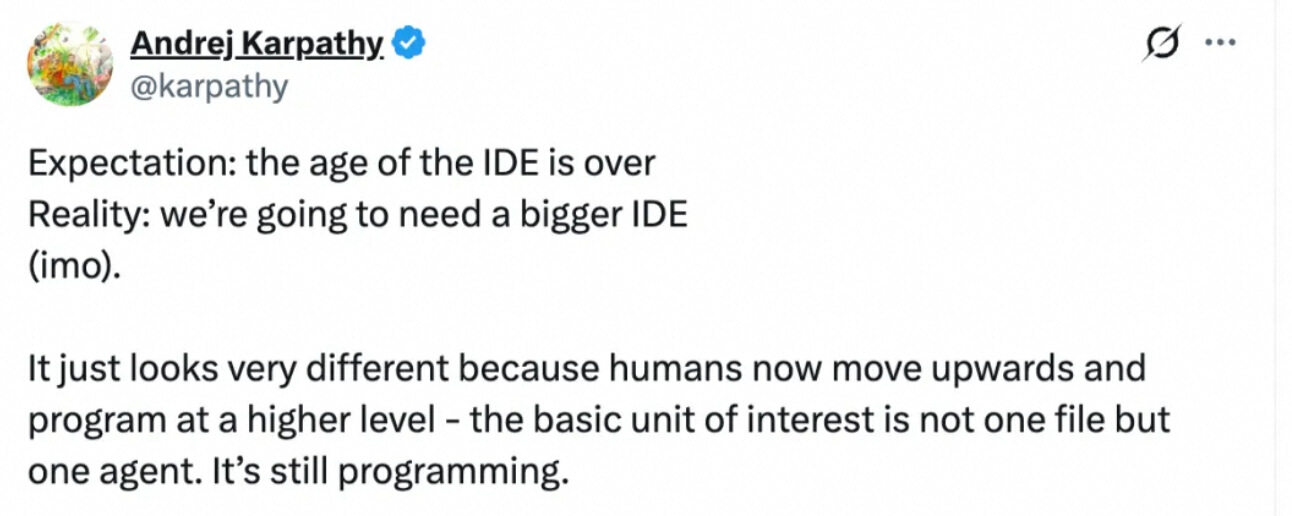
This shift also requires the AI IDE to move from simply writing code and organizing files to organizing agents. This also aligns with Karpathy's prediction: in the AI Coding era people still need an IDE, and even need a larger IDE to manage agents. This is the future direction of the IDE.
 Now, after testing Qoder's Experts Mode, I have already seen the future of AI Coding and the AI IDE in it.
This article is reprinted from QbitAI | WeChat Official Account QbitAI
Now, after testing Qoder's Experts Mode, I have already seen the future of AI Coding and the AI IDE in it.
This article is reprinted from QbitAI | WeChat Official Account QbitAI
The Qoder Expert Team Speed-Runs a Personal Blog with Me
After opening Qoder in Editor mode, click "Toggle AI Sidebar" in the top-right corner, then click the mode-switch button at the bottom center, and you can use Experts Mode.
To quickly test the expert team's capabilities, I chose to start from scratch and build a simple personal blog project. After I entered the project requirements, the expert team's "commander," the Team Lead, automatically broke my requirements into 8 tasks and dispatched them to different cyber engineers.
The first one the Team Lead sent out was general engineer Nick. He isn't responsible for the actual development—since I currently had only an empty folder and lacked the environment the project needed, Nick first had to install dependencies for me, set up the basic project structure, and initialize the project.
During this process, Nick also ran into some problems, which it overcame on its own.
In the end, Nick smoothly completed the task and reported back to me.
Then Nick handed off the work to his "colleague"—backend engineer Jimmy. But unlike a human backend engineer who handles both backend development and the database, Jimmy was only responsible for initializing the database—showing just how fine-grained the division of labor is in Experts Mode.
After Jimmy finished building the database, the project could officially start writing code. The Team Lead divided the work by module among 5 engineers, who were respectively responsible for frontend pages, middleware, and backend API development—very comprehensive.
It looks like a linear process, but in fact multiple engineers were advancing the project at the same time during development. This undoubtedly sped up development efficiency, and it's also one of the advantages of multi-agent collaborative programming under Experts Mode.
After the previous 7 "colleagues" completed development, the project commander Team Lead also arranged for testing engineer Chris to perform full-process validation.
Chris directly opened the browser, entered the account and password, logged into the website, and then fully tested the entire create-read-update-delete logic.
At the same time, it automatically saved screenshots of key pages to display the test results.
After the testing was done, the project development still wasn't over—I also had the system review the code quality, so the Team Lead added another expert, code reviewer Mark, who found multiple system vulnerabilities and even graded them by severity.
I then had the expert team fix the vulnerabilities. The experts didn't fix them one by one directly; instead, they first analyzed the situation, then found that two tasks had no dependency on each other and could be developed independently, so two experts completed the tasks in parallel—clearly more efficient.
At this point, all development and testing work was complete. With the help of the 8 experts on Qoder's expert team, it took me just 16 minutes to have a personal blog website. It has complete create-read-update-delete logic, with a front-end display page and a back-end management page.
But the technical architecture was still rather crude, without frontend-backend separation, so I decided to raise the difficulty and test the expert team's refactoring ability, asking it to refactor the backend using Spring Boot (a Java development framework) and MySQL (a relational database).
The Expert Team Refactors Together, Building AI Tools with AI
I first, as before, told the Team Lead my requirements. After a feasibility analysis of these requirements, the Team Lead asked me a few questions, each offering three options; after I made my decisions, the Team Lead then dispatched a new expert, Alex.
Alex is a researcher, responsible for analyzing my current project structure and code interfaces, then formulating a complete refactoring plan and writing it into markdown to guide the subsequent spec-driven development.
With the refactoring plan in place, the Team Lead began directing the engineering team to work, and a new role appeared: operations engineer Nick, responsible for installing MySQL for me.
After MySQL was installed locally, I worried there might be version conflicts between different components, so I stepped in at this point to raise the question on my mind, and the system gave a reassuring answer. This is also a feature of Qoder's Experts Mode: developers can step into the process at any time to raise questions or change requirements.
This design is quite true to life—after all, which developer has never had a product manager tack on extra requirements (doge).
Next came the normal advancement of the project and automatic debugging. Frontend and backend were advanced simultaneously multiple times along the way, and in the end the project was efficiently refactored and the tech stack was rewritten.
But I didn't stop there. How can software built by AI Coding not have AI? I again asked the expert team to integrate the Qwen API for me and set a theme, so that AI could directly write articles for me in the future. Why Do We Need an "AI Coding Expert Team"?
"Since last December, AI Coding has undergone a qualitative change"—this remark by the guru Karpathy recently sparked heated discussion in the industry.
Karpathy once proposed and popularized the concept of "Vibe Coding," and now he has once again perceived a shift in the direction of AI programming. Karpathy believes that AI programming agents are now far more capable than before and can tackle large projects and long-term tasks.
This means AI programming has shifted from Vibe Coding to Agentic Engineering—AI is no longer just simply completing code, but has begun to fully build projects in the form of agents.
The new paradigm in AI programming has also given rise to new problems.
On one hand, there's the code quality problem. Currently many mainstream AI Coding tools are still single-agent-based; they're fine for simple tasks, but once facing complex tasks—such as multi-round iteration or refactoring a project—their context length may not hold up, ultimately making development like a bear picking corn: working on the feature at hand while forgetting the earlier tasks, with a fragmented logic chain and worrying code quality in the end.
On the other hand, there's room to improve efficiency. Large projects are very complex, involving all kinds of work—frontend UI, backend development, and database design. Some tasks could clearly be executed separately, and real-world teams often arrange them that way, but under single-agent programming, you're still forced to wait.
Qoder's Experts Mode happens to solve both pain points of quality and efficiency. From the hands-on experience above, the expert team isn't simply piling up the number of agents—it's a true multi-agent system. Because the experts it assigned me have different specialties, and as described they actually work in their own independent contexts, so with mutual collaboration they can clearly handle more interaction rounds.
To address the context problem, Qoder specially built an engineering knowledge engine—a code cognition system that can use multi-dimensional data sources, integrating your code files, commit history, Repo Wiki, and memory to optimize the experts' ability to deeply understand context.
In addition, during testing I repeatedly found scenarios where multiple experts advanced work at the same time—in which case the experts wrote different pages separately, or developed frontend and backend separately, which undoubtedly sped up the project's progress.
These are the characteristics I've perceived so far. It's said that the expert team's agents also autonomously learn new Skills, self-evolve, and get smarter and more attuned to me the more I use them. The new mode just launched, so I haven't discovered this feature yet; I'll share more with everyone when I have the chance.
Overall, Experts Mode speeds up development efficiency and improves code quality. Qoder tested Experts Mode's code quality using an internal complex-task benchmark, and the results showed that Experts Mode scored 67% higher than its own single-agent mode, leading Claude Code Agent Teams by 16%.
Clearly, Qoder's Experts Mode is opening a new stage.
Ushering in the Era of Multi-Agent Collaborative Programming
After vibe coding and agentic coding, AI Coding is shifting toward the era of multi-agent collaborative programming.
Behind this is a change in user needs: they are no longer satisfied with AI simply writing code, but hope that AI can efficiently deliver software, with guaranteed software quality. A single agent clearly can no longer meet this need, so moving toward multi-agent collaborative programming becomes inevitable.
Multi-agent collaborative programming further amplifies individual capability, giving an individual a digital legion that is on standby at all times, continuously evolving, and understands not just programming but engineering.
This shift also requires the AI IDE to move from simply writing code and organizing files to organizing agents. This also aligns with Karpathy's prediction: in the AI Coding era people still need an IDE, and even need a larger IDE to manage agents. This is the future direction of the IDE.