Within 51job's technical team, a hypothesis is being validated: the future measure of programmer value will no longer be lines of code written, but AI resources mobilized.
From "Handcrafted Code" to "Project Manager"
A widely circulated diagram within 51job's technical team illustrates three stages of developer role evolution.
Stage one is the "Executor," jokingly called "handcrafted code"—developers spend their days writing code, finding bugs, and fixing bugs. Solid work, but grueling.
Stage two is the "Collaborator," where AI begins participating in coding. Developers learn to write prompts and refine AI output, and human-AI collaboration takes shape.
Now, the company is pushing toward stage three—developers become "project managers" for AI Agents, responsible for requirement decomposition, boundary definition, and final acceptance. They steer direction rather than handwrite every line of code.
This transformation sounds radical, but 51job's approach is pragmatic: not a one-size-fits-all mandate, but starting from concrete scenarios and letting tools handle the most tedious work first.
First Cut: Eliminating Repetitive Labor
Any programmer with large-project experience knows that truly creative thinking time is limited. Most hours go to repetitive manual work—code entry, logic structuring, writing unit tests, copy-pasting template code.
51job introduced Qoder on the IDE side to let AI handle this work. Developers describe requirements through conversation; Qoder generates code directly, and developers review and adjust.
But the real surprise for the team wasn't daily coding—it was the perennial headache plaguing all technical teams: legacy project maintenance.
Savior of "Legacy Code Mountains"
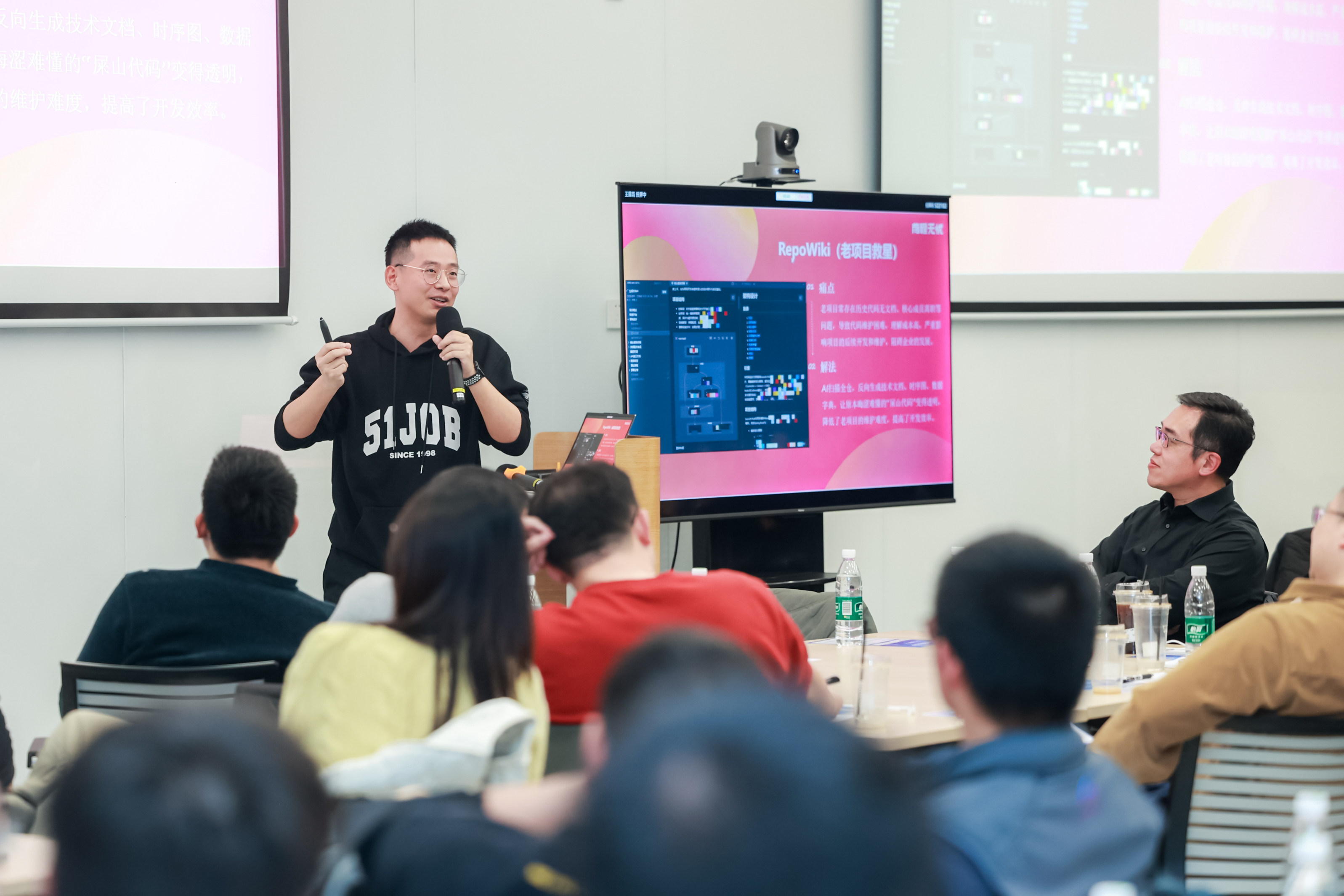
Nearly every established internet company has "legacy code mountains"—missing historical documentation, core developers long gone, new hires staring blankly. This code is too risky to touch, too painful to maintain, yet carries critical business.
More Than One Tool: A Differentiated Tool Matrix
51job didn't bet on a single tool. They built a differentiated tool matrix.
On the IDE side, Lingma and Qoder provide immersive AI coding capabilities, covering daily development scenarios—permission management, usage analytics, Quest mode, RepoWiki, department-level RAG knowledge bases, and other enterprise features.
More noteworthy is the introduction of QoderWork—it breaks traditional coding boundaries, enabling non-technical staff to complete business processing through natural language. For example, a department assistant can simply say "Help me verify the headers and tax numbers for all invoice PDFs this month, and generate an Excel sorted by date," and QoderWork handles it automatically.
Management's Task: Establishing "Enterprise Dialect"
Tools are selected, but if everyone uses them differently with uncontrollable output, AI becomes an expensive toy. 51job did something critical at the management level—establishing a standardized Rules+Spec system.
Simply put: setting rules for AI. Rules unify input formats, reduce ambiguity, lower token consumption, and ensure AI output remains consistent and reproducible. More importantly, these rules transform individual experience into organizational standards, aligning AI behavior with engineering standards and business goals.
The company also makes heavy use of Quest mode in Qoder—a highly interactive, task-oriented development approach particularly suited for complex logic exploration. Developers engage deeply with AI, gradually decomposing and solving complex problems.
Leap from Individual to Platform
Even more impressive is 51job's layout in skill management. They've built a Skills/MCP/Workflow platform, establishing a "skill leaderboard" mechanism that encourages employees to contribute automation scripts and AI skills.
This isn't a top-down mandate, but a bottom-up emergent pattern. Timesheet reporting, weekly report generation, data processing—these daily chores have been spontaneously turned into reusable AI skills by employees.
Workflow's value lies in upgrading fragmented AI single skills into organizational production systems. Through visual process orchestration, prompts, tool calls, knowledge bases, and business logic are crystallized into reusable capabilities, reducing dependency on individuals and improving overall collaboration efficiency.
Knowledge Flywheel: Taking Experience Out of Veterans' Heads
51job's thinking on knowledge crystallization is particularly deep. They've built a "produce → crystallize → collect → distribute" knowledge closed loop.
Previously, business logic existed only in veterans' minds; new hires needed months to get up to speed. Now through knowledge crystallization, this experience is fed back in real-time to every developer's AI assistant. AI assistants can call upon crystallized knowledge to help developers access needed information faster during development, reducing repetitive work.
This creates a positive flywheel: more usage → more crystallization → AI understands business better → team efficiency increases. 51job calls this "Knowledge is Oil"—computing resources will become increasingly cheap, but enterprise crystallized knowledgebases deeply coupled with AI are the true moat.
Elevating Measurement Standards
When developer roles fundamentally change, evaluation systems must change too.
As a tech company actively embracing transformation, 51job is driving a metrics revolution. Past developer measurement relied on lines of code, CR correction count, adoption rate—these essentially measure manual labor. Future core metrics will shift to TPM/RPM (Token consumption density), reflecting developer activity and efficiency in mobilizing AI resources.
Evaluation dimensions have also shifted from "how much code was written" to three aspects: deep business understanding, problem discovery ability, and system architecture imagination. These are the truly scarce capabilities in the AI era.
Final Words
51job's practice paints a complete picture of AI programming adoption in large internet enterprises—not simply buying a tool, but comprehensive transformation from tool selection, standard building, skill platforms, knowledge crystallization to evaluation systems.
Qoder plays a central role: immersive IDE coding, RepoWiki's legacy project rescue, Quest mode's deep exploration, QoderWork's coding boundary breakthrough—covering full-chain scenarios from daily development to organizational empowerment.
More noteworthy is a judgment from the 51job team: the future is the "AgenticEverything" era, where everyone will have dedicated Agents that understand business, engineering, and processes. GUI operations will be replaced by LUI (Language User Interface).
In this direction, they've already taken the first step. As a leading domestic human resources service provider, 51job will actively transform its tech innovation achievements into products and services, enabling enterprise clients and individual users to enjoy AI dividends firsthand, guiding the human resources service industry toward a more efficient digital-intelligent future.
This article is based on Cao Huanglin's offline sharing "Vibe Coding Adoption Practice in Large Internet Enterprises" as C-end Technical Lead at 51job technical team