

Teams analytics: dashboard metrics, permissions, and how AI share of commits is calculated.
Applicable plans: Teams, Enterprise
Dashboard metrics
AI share of committed code
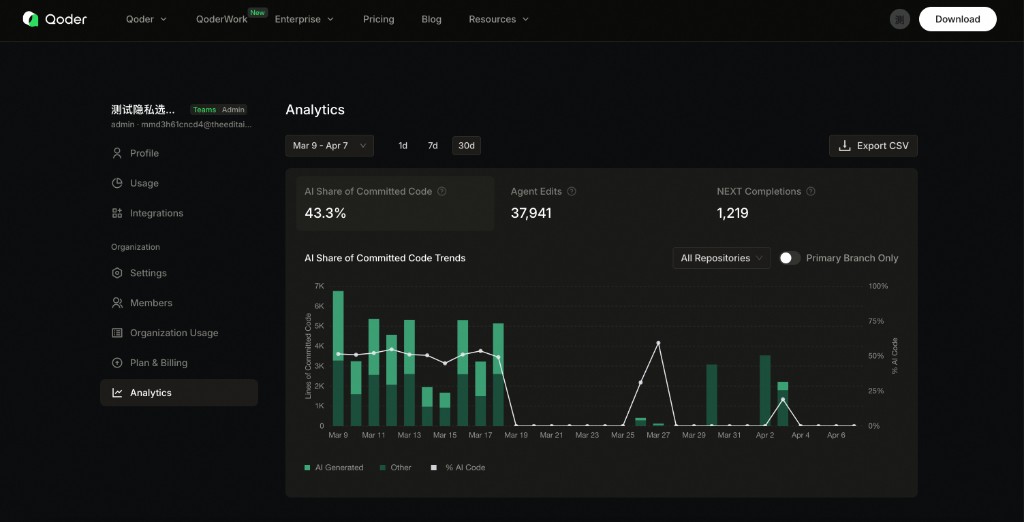
- Filter by repository (derived from Git metadata).
- Option to main branch only.
Agent retained lines
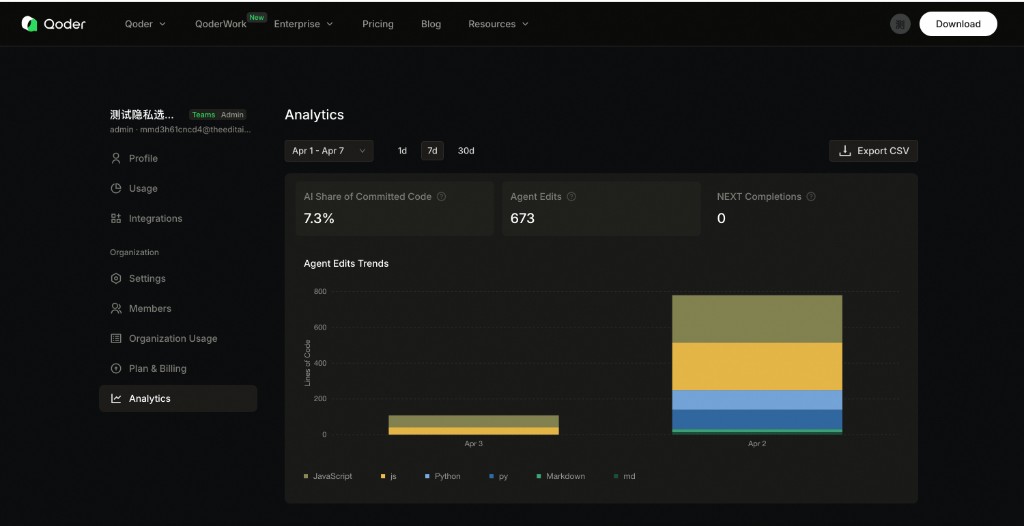
- Front end:
.js,.jsx,.ts,.tsx,.vue,.svelte,.html,.css,.scss,.less,.sass - Back end:
.py,.java,.go,.rs,.rb,.php,.cs,.kt,.scala,.swift,.m - Systems / low-level:
.c,.cpp,.h,.hpp,.asm - Scripts / config:
.sh,.bash,.zsh,.ps1,.bat,.yaml,.yml,.toml,.json,.xml,.ini,.env - Data / query:
.sql,.graphql,.prisma - Mobile:
.dart,.swift,.kt - Docs / markup:
.md,.mdx,.rst,.tex - Other:
.r,.lua,.perl,.ex,.exs,.clj,.hs,.erl,.zig,.nim,.proto,.tf,.dockerfile
NEXT acceptances and recommendations
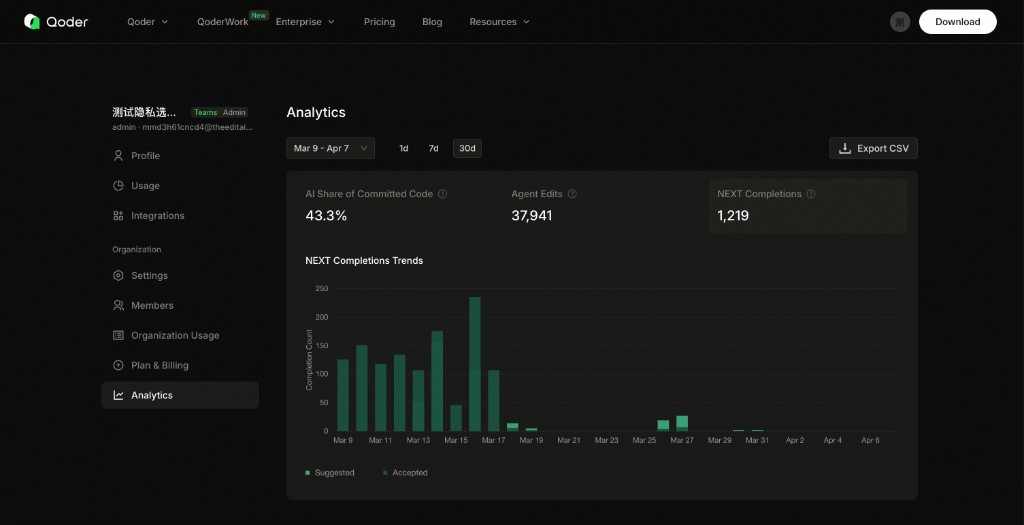
- NEXT acceptances: Total accepted NEXT completions.
- NEXT recommendations: Total NEXT suggestions shown.
Permissions
Data metrics are available to members of organizations where the capability is enabled. Role controls scope:
| Role | Access |
|---|---|
| Admin | Organization-wide metrics. |
| Member | Own metrics only. |
AI share of committed code: rules and attribution
The table below describes which kinds of commits are included or filtered under the current policy. Applied means the rule participates in filtering or counting for this metric.
| Rule | Description | Applied |
|---|---|---|
| Huge commit filter | Typical of bulk dependency imports, migrations, vendor drops, and similar non-hand-authored changes; abnormally large single commits may be detected and excluded from this metric | Yes |
| Merge-only / local merge | Commits that mainly reflect pull/merge/sync without substantive code changes are generally excluded from this metric | Yes |
| Revert commits | Rollbacks of earlier commits; not excluded under the current policy | No |
| Squash / amend | In some workflows or toolchains, the same change set may be counted more than once | Yes |
| Bulk format-only commits | Pure formatting from common code formatters; not excluded under the current policy, to stay consistent with post-processed code states | No |
- Sync-style merges: Changes that are merges from a remote into a local checkout without substantive code edits are not included in the basis used for this metric’s AI attribution (aligned with Merge-only / local merge above).
- Renames and copies: If you only rename paths after generation, or copy generated content to a new path and commit there, the new path usually cannot be attributed to Qoder AI under the rules, so those changes do not count toward this metric’s AI-generated tally.
- Multiple directories / worktrees: If checkout paths change often (multiple working directories, worktrees, etc.), changes can still count when they remain attributable to generation under the product rules.
- Amend and follow-up commits: After amend or similar rewrites, lines that are still Qoder AI–generated continue to count as AI-generated.
- Very large dependency or artifact files: Accidentally committing huge
.module-style artifacts usually falls under abnormally large commit handling; such commits may be excluded wholesale from the basis of this metric—see the dashboard.